
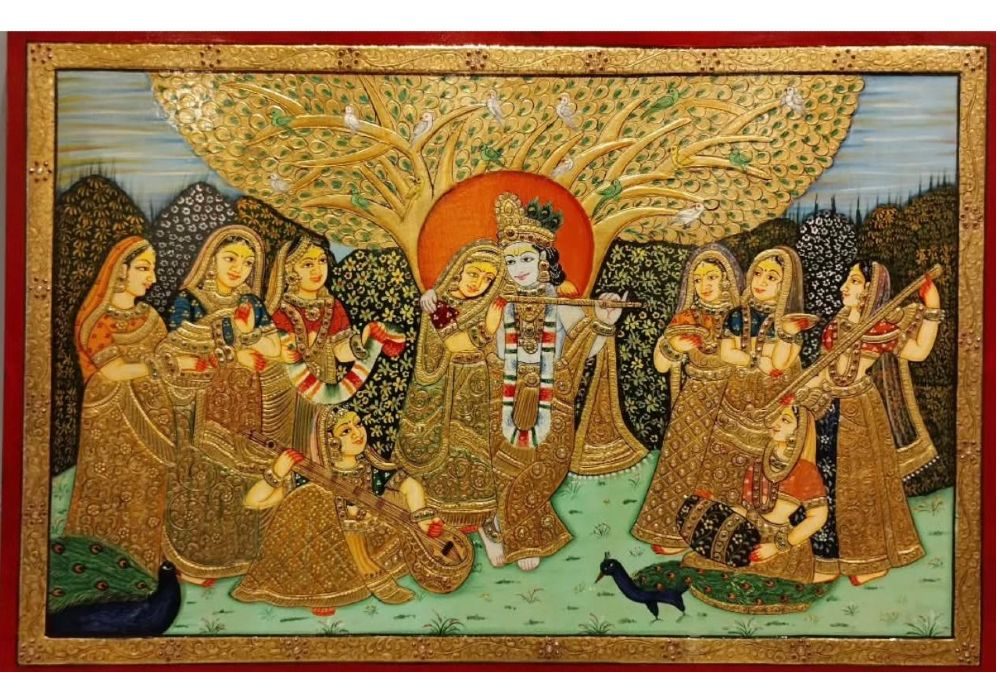
The Allure of Tanjore Painting: A Journey Through History, Craftsmanship, and the Artisan’s Soul
India, known as Artristy World and one of the most religious places with a rich tapestry of art and culture, has given rise to some of the most extraordinary artistic traditions. Among the most celebrated is its timeless art.
Ortir India explored the Allure of Tanjore Painting — known for its vibrant hues, intricate designs, and mesmerizing golden sheen, Tanjore painting stands as a testament to the country’s devotion, craftsmanship, and heritage.
Beyond the colors and patterns lies a deep, emotional connection to the centuries-old traditions and the artisans who devote their lives to preserving and enhancing this remarkable art form.
There is a story deeper behind the Tanjore Painting when Ortir India put it on their platform.
I was deeply inspired by the historical art and powerful imagery of Tanjore painting. On the auspicious day of Basant Panchami — a day that marks the arrival of spring and the farewell of winter — it’s the season filled with vibrant yellow: the blooming of mango tree flowers and the sweet smell of yellow sarson flowers in the village heart.
Spring has always been one of my favorite seasons, and that day, I had the privilege of meeting Sawant, an artisan of Tanjore. On that special day, he was in the midst of creating a beautiful depiction of Ma Saraswati, the goddess of wisdom, knowledge, and arts—an iconic figure deeply revered in Indian culture.
The blend of the season’s energy and the divine grace of Ma Saraswati felt like the perfect alignment of nature and spirituality.
As I watched him work, I couldn’t help but feel a surge of excitement. The vibrant energy of Basant Panchami, a day symbolic of new beginnings, seemed to mirror the energy of the Tanjore painting—each brushstroke a testament to the dedication, emotion, and skill of the artist.
Sawant, deeply engrossed in his work, shared with me the intricate techniques behind Tanjore painting, where each line, every shimmering layer of gold, and each vibrant hue is more than just a part of the artwork—it is an embodiment of the artist’s soul.
He spoke of how, for him, painting was not just about the strokes of the brush, but an emotional expression, a divine offering. It was as though every drop of sweat and every tear that fell while painting had a purpose.
Tanjore art, for Sawant, was a way to communicate his devotion to the goddess—a medium through which he could pour his emotions and reverence into the art form, connecting with Ma Saraswati on a deeply spiritual level.
In that moment, I understood that Tanjore painting is more than an art—it is a sacred conversation between the artist and the divine, where each painting is a heartfelt expression of faith, a story woven through the eyes and hands of the artisan.
The History of Tanjore Painting
Tanjore painting hails from the southern part of India. The origins of this art form can be traced back to the 16th century, dedicated to the goddess, supreme power, and the growing devotion to Hindu gods and goddesses.
The Tanjore style was initially confined to temple art, where artists would create devotional images of gods, goddesses, and religious figures in a temple-inspired style. It was believed that these sacred depictions were meant to bridge the divine and human worlds, offering blessings and prosperity.
What makes Tanjore painting truly unique—even in the diverse world of Indian art—is the application of gold foil. Artists meticulously layer thin sheets of gold onto the surface of the painting, creating a reflective effect that symbolizes divine light and energy.

The process is delicate, and each step requires an incredible amount of focus and patience. That’s why Tanjore paintings are said to shine with golden light even in the dark of night.
The result is an art form that glows with an otherworldly beauty—one that shines with the radiance of the gods themselves.
Tanjore paintings feature a variety of themes, but the most common subjects include:
- Religious figures and deities
- Scenes from nature
- Customized depictions for spiritual or aesthetic purposes
The figures are often shown in a highly stylized, almost symmetrical manner, with exaggerated facial expressions and graceful postures. The use of vibrant colors, along with the iconic gold embellishments, makes the paintings appear alive, vibrant, and imbued with spiritual energy.
The Artisan’s Touch: A Journey of Painstaking Craftsmanship
While Tanjore painting is a collective cultural achievement, its true beauty lies in the hands of the artisans who painstakingly create each piece. The journey of creating a Tanjore painting is both an artistic and spiritual one.
It is said that an artisan must first prepare himself mentally and spiritually, for he is not just creating an image of the divine, but inviting the divine presence into his work. This is where the deep connection to history, faith, and artistic tradition comes into play.
The process of making a Tanjore painting is long and intricate. It begins with the preparation of the base—typically a wooden board that is first carved and then covered with a thin layer of clay.
The clay is applied and shaped with precision to form a three-dimensional structure. The next step involves the application of gold foil—one of the most distinctive elements of Tanjore painting. The foil is carefully laid over the design to create the gleaming gold effect that brings the painting to life.
The artist then works with colors and fine brushes to complete the intricate details of the image, paying special attention to:
- Shading
- Clothing and ornamentation
- Jewelry detailing
- Facial expressions
As the work progresses, the artisan pours his heart and soul into every brushstroke, refining the details and ensuring that the figure reflects the purity and grace of the divine.
“Tanjore painting is not only about the physical process—it is a spiritual journey for the artist as well. The craftsman spends days, weeks, or even months on a single painting, devoting himself to the task with unwavering focus.”
Each brushstroke is an act of reverence, and each detail is imbued with devotion. The creation of a Tanjore painting becomes a meditative process where the artisan is not merely painting but connecting with the divine energies that permeate his work.
It is said that many artists lose themselves in the process, becoming so absorbed in their task that they experience a deep spiritual connection to the figures they paint.
The Artisan Who Shines Through Tears: A Story of Perseverance
But behind every glowing Tanjore painting is the story of an artisan, often working under the most difficult of circumstances, who has poured his heart, soul, and even his tears into the creation.
Artist Sawant, whose journey exemplifies the sacrifices, hardships, and unwavering dedication that characterize the life of a true Tanjore painter from a very early age, is one such individual whose life has been intertwined with the legacy of Tanjore painting.
Born in a small village near Thanjavur, Sawant grew up in a family of artists. From a young age, he was taught the craft of Tanjore painting by his father — a master artisan known for his intricate details and unique style.
Sawant’s early years were spent watching his father create stunning pieces of art, fascinated by the way the gold foil glistened under the light and the rich colors seemed to breathe life into the figures.
Sawant was a fully devoted follower of Ram Darbaar and Lord Krishna Ji. As he grew up and learned more about India’s religious traditions, he gave his best efforts to also learn another sacred form of painting: Pichwai art, which is equally devoted to divinity.
The village was poor, and the demand for Tanjore paintings was inconsistent. While there were moments of prosperity, there were long periods of hardship when his father’s work didn’t sell.

Sawant remembers the long nights when his father would stay up, working by the dim light of a kerosene lamp, refining a painting with painstaking detail. His father, despite the hardships, never complained.
“The work is sacred,” he would say. “Every brushstroke is a prayer.”
The rise of modern art and mass production methods began to overshadow traditional craft forms, and fewer people were interested in paying for hand-painted Tanjore pieces.
There were days when Sawant would sit with his paintings, gazing at them as if searching for answers. He often found himself on the verge of giving up. The work was exhausting — both physically and emotionally — and the pressure to meet deadlines only added to his struggles.
Yet, it was during these moments of uncertainty that Sawant would recall his father’s words:
“Art, like life, must be lived with devotion.”
One evening, as Sawant worked on a particularly delicate Tanjore painting of Lord Krishna, he experienced a profound moment of clarity. He had been struggling with the placement of the gold foil on the deity’s crown, unable to get the reflection just right.
In frustration, he wiped his brow, and for a moment, a tear fell onto the canvas. It was not an ordinary tear, but one filled with years of hope, sacrifice, and reverence.
When he looked at the tear, something remarkable happened. The gold foil absorbed the tear, and the crown of Lord Krishna, adorned with a little cow and Gopis, gleamed brighter than before. It was as if his own heart had merged with the divine, making the painting come alive with a radiance he had never seen before.
From that day on, Sawant believed that his tears were an essential part of the work—proof that the artist’s soul had been poured into the painting. He began to see his craft not as a labor, but as a form of spiritual communication.
The tears that fell from his eyes were no longer a symbol of his struggle, but a testament to his devotion and love for the art form.
He understood that the true allure of Tanjore painting did not lie only in the materials or the techniques, but in the heart of the artist who created it.
The Legacy of Tanjore Painting: An Enduring Tradition
Today, Tanjore paintings continue to be highly regarded around the world—both nationally and internationally—prized not only for their beauty but also for their cultural significance. While the world has changed, the essence of Tanjore painting has remained steadfast, upheld by artisans like Sawant, who continue to carry the tradition forward.
Where the younger generation may struggle to understand the allure of Indian artistry, Sawant stands as a convener of tradition—presenting historical culture and the divine presence of the gods through his Tanjore paintings. The allure of Tanjore painting lies not only in the gold that adorns each piece, but in the story behind every brushstroke—the story of the artisans who, through their hands, pour their devotion, history, and tears into creating art that transcends time.

Their art is more than decoration—it is an offering, a prayer, and a connection to the divine.
As long as there are artisans like Sawant, Tanjore painting will continue to shine brightly—its golden glow a reflection of the enduring spirit of India’s iconic art. The allure of Tanjore painting will forever remain intertwined with the story of the artisans who dedicate their lives to it, ensuring that each painting carries not only beauty but also the profound soul of its creator.
Let’s come together and celebrate the tears of the artisan’s soul through the exquisite art of Tanjore painting.
There’s an old proverb that says, “The wall has ears.” But at Ortir India, we believe every wall speaks a language of its own. Every corner holds a story. We hear, we see, and we feel that each space is more than just a structure—it’s a divine expression.
With the radiant light of Tanjore painting, every wall becomes a temple, and every corner shines with divine grace.
At Ortir India, we transform your home into a sacred haven, where each wall is not just a backdrop but a canvas of spiritual connection and beauty. With Tanjore painting, your home isn’t ordinary—it’s a place where light and art merge, creating an atmosphere that reflects the divine.
Come, celebrate the allure of Tanjore painting with us. Let the art of the artisans pour through your walls, filling your home with sacred light and divine energy.
Together, we will create a space where every corner tells a story, every wall speaks a prayer, and your home becomes a living testament to the beauty of India’s iconic art.
Recent Comments