
Exploring the Timeless Appeal of Indian Pichwai Art

Some forms of art are meant to decorate walls.
Others are meant to hold centuries.
Pichwai paintings belong to the latter. They are not created for momentary admiration or fleeting trends; they are born from devotion that outlives generations. Each Pichwai is a sacred pause in time – where faith, culture, memory, and meticulous craftsmanship merge into one silent yet eloquent presence.
The intricate detailing of Pichwai paintings transcends mere artistry. It becomes a sacred treasure, a divine luxury shaped not by ambition, but by surrender. These paintings emerge from the hands of artisans who carry within them the weight of countless generations – of whispered mantras, inherited discipline, unspoken sacrifices, and dreams devoted not to personal fame but to divine service.
Pichwai is not just something you look at.
It is something that looks back at you – quietly, patiently – until you soften.
These paintings are living embodiments of faith, culture, and timeless tradition. They do not exist to impress; they exist to remind us of something we have slowly forgotten – that art can still be an act of worship. ✨
The Origins of Pichwai Art: When Faith Took Form
The word Pichwai literally translates to “that which hangs behind.” Traditionally painted on cloth and displayed behind the deity in temples, Pichwai art was never meant to be isolated or autonomous. It was conceived as a companion to the divine presence – an extension of the sanctum itself.
More than four centuries ago, history shifted quietly but profoundly. To protect the sacred idol of Shrinathji – a youthful manifestation of Lord Krishna lifting the Govardhan Hill – from Mughal invasions, devotees moved the deity from Vrindavan to Nathdwara in Rajasthan. This migration did more than preserve an idol; it gave birth to a cultural and artistic lineage that would endure for centuries.

Nathdwara did not merely become a place of worship.
It became a living atelier of devotion.
Here, art was not an individual pursuit. It was collective, sacred, and continuous. Pichwai paintings became an integral part of temple rituals, festivals, and seasonal observances. They were created not for ownership, but for offering. 🕉️
Artists did not sign their work.
They did not claim authorship.
They dissolved themselves into service.
The craft passed quietly from one generation to the next – through observation, repetition, and discipline. Fathers trained sons. Gurus shaped disciples. The learning was slow, deliberate, and deeply spiritual.

Every brushstroke carried not just skill, but responsibility – the responsibility of preserving a divine narrative exactly as it had been told for centuries.
The Silent Dialogue Between Viewer and Canvas

To stand before a Pichwai painting is to enter a dialogue without words.
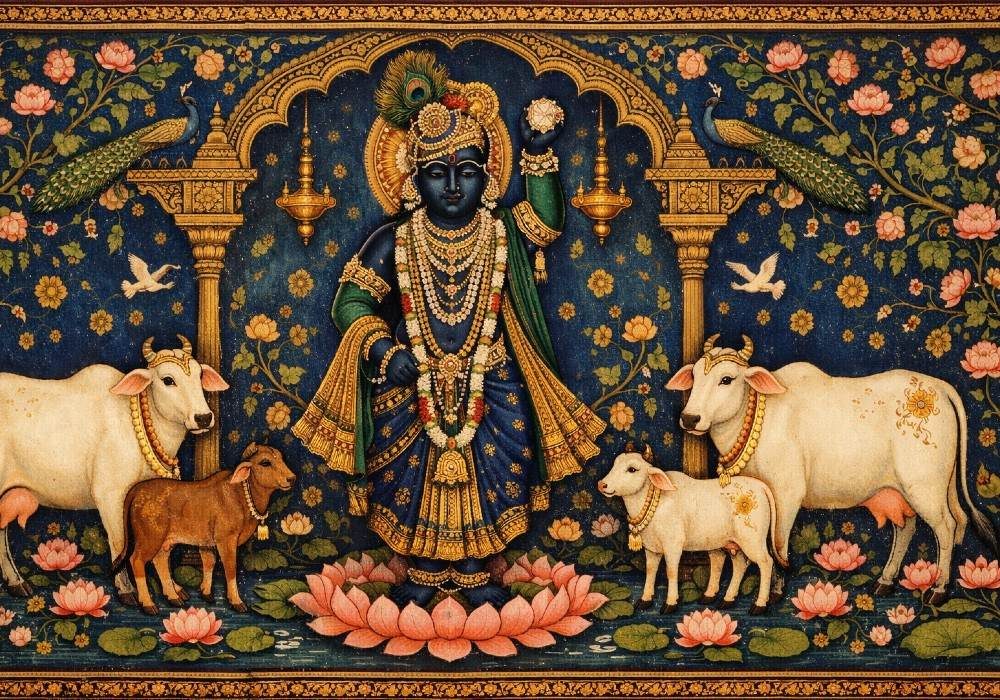
Imagine gazing upon a scene where Lord Krishna stands beside his nurturing cow mother, a gentle calf resting nearby. At first, you notice the composition. Then the colors. And then – something shifts.
The whiteness in the painting glows with an almost impossible purity. It feels as though someone, by a tender and sacred accident, spilled warm, fresh milk across the canvas. That white is not empty – it is alive. It breathes. It hums softly.
Your heart slows.
Your eyes linger longer than expected.
There is a stillness that descends upon you – a quiet awe that cannot be explained, only experienced. The painting refuses to be consumed quickly. It demands presence.
This is where Pichwai reveals its true power. It pulls you inward, urging you to look beyond pigments and patterns, into the unseen labor behind them. You begin to sense the endless hours spent in silence, the dimly lit rooms, the aching backs, the steady hands guided by faith rather than haste.
Every brushstroke feels like a prayer uttered without sound. Every detail is stitched together by patience, love, and surrender.
“Pichwai artisans are not merely craftsmen –
they are storytellers of the unseen,
dreamers who paint devotion,
and guardians of a sacred inheritance.
Their art asks the world to slow down,
to feel deeply,
and to remember the timeless magic of tradition.”
The Artist as a Chosen Vessel
There is a belief whispered quietly among those who know this art intimately – that Pichwai artisans are chosen, not trained.
It often feels as though Lord Krishna himself selects his storytellers. As if he places a quiet calling in their hearts, guiding their hands long before they understand the weight of what they carry.
These artists paint not only with skill, but with tears, discipline, and unwavering devotion. Their lives are shaped around their craft. Their time belongs to precision. Their emotions are poured into color.
They do not paint Krishna as an external subject.
They paint him as an internal presence.
In truth, they are not merely artists. They are a divine medium – a bridge between humanity and God. Through their religious and spiritual imagery, they connect the viewer to something vast, gentle, and eternal.
Their paintings hold more than color and form. They carry blessings. They carry love. They carry a spiritual resonance that lingers in the space long after the gaze has moved on.
To behold a Pichwai painting is not to witness art.
It is to experience a moment of communion.
Themes and Symbolism: The Living Soul of Pichwai
Pichwai art speaks a language made of symbols, stories, and seasons. Every element holds meaning. Nothing is accidental.

1. Shrinathji: The Eternal Center
At the heart of every Pichwai stands Shrinathji – Krishna as a seven-year-old child lifting the Govardhan Hill. This image captures more than divine strength; it embodies protection, compassion, and reassurance.
It is a reminder that the divine does not dominate – it shelters.
That power can be gentle.
That faith can hold the weight of the world.
2. Seasons as Sacred Time
Pichwai paintings shift with seasons and festivals, mirroring the rhythms of nature and devotion.
- Monsoon Pichwai celebrates abundance – lush greenery, silver rain, renewed life.
- Janmashtami Pichwai blooms with floral opulence, honoring divine birth and joy.
- Holi Pichwai erupts in playful color, reflecting Krishna’s leela and boundless love.
These paintings remind devotees that spirituality is not static – it moves, breathes, and changes with time.
3. Leelas: Stories That Awaken Emotion
Krishna’s childhood antics, his playful theft of butter, his interactions with the gopis – these narratives are central to Pichwai art. They are not distant myths, but intimate moments.
They evoke love without possession.
Joy without reason.
Devotion without fear.
Through these scenes, the divine becomes approachable, human, and deeply affectionate.
4. Motifs as Sacred Symbols
Every motif in Pichwai art speaks softly but clearly.
- Lotuses symbolize purity and spiritual awakening.
- Peacocks represent beauty, grace, and divine playfulness.
- Cows embody nourishment, prosperity, and compassion.
Intricate floral borders frame the divine narrative like hymns woven into cloth, offering visual reverence.
The Artistry Behind the Devotion
What makes Pichwai truly remarkable is not only what it depicts, but how it is created.
Natural Pigments: Earth as Offering
Traditional Pichwai artists use colors derived from minerals, vegetables, and precious stones. These pigments are prepared slowly, reverently, and with precision. Their longevity reflects their origin – rooted in nature itself.
Fine Detailing: Where Patience Becomes Prayer
Using brushes made from squirrel hair, artists create details so fine they demand complete surrender to the process. Gold and silver foils are applied delicately, lending the painting a luminous, divine aura.
Every inch requires focus. Every mistake demands humility. This is not a craft for haste – it is a discipline of stillness.
Cloth as Living Canvas
Cotton or silk cloth serves as the canvas, stretched carefully over wooden frames. The fabric absorbs pigment differently than paper, giving the painting depth, texture, and warmth.
The canvas does not merely hold the image – it participates in it.
Pichwai in the Modern World: A Quiet Resistance
In a time obsessed with speed, replication, and instant consumption, Pichwai stands as a quiet act of resistance. It refuses shortcuts. It refuses dilution.
It reminds us that some things take time because they are meant to.
Today, as Pichwai finds space in homes, galleries, and global collections, its essence remains unchanged. It continues to whisper devotion in a world that often forgets how to listen.
Pichwai is not an object.
It is an experience.
It teaches us that art does not always need to shout. Sometimes, it whispers – until the soul remembers how to hear.
So when you encounter a Pichwai painting, do not rush.
Do not analyze.
Stand still.
Breathe.
Feel.
Because somewhere within those colors,
within that silence,
within that devotion –
Krishna is waiting.
The Hands That Remember
In the narrow lanes of Nathdwara, where temple bells mark time and devotion lingers in the air, the day begins early for a Pichwai artisan.
Before the brush is lifted, there is silence.
Before color touches cloth, there is prayer.
For this artisan, painting is not work – it is memory. His grandfather painted behind the temple walls, his father learned by watching, and he himself grew up among pigments ground by hand and cloth stretched patiently across wooden frames. No formal classroom, no written manuals – only observation, repetition, and faith.
At ORTIR India, we honor these hands that remember – hands that carry centuries of tradition without ever needing to announce it.

A Childhood Shaped by Color and Devotion
Many Pichwai artisans begin their journey before they understand the meaning of the word “art.”
As children, they sit beside elders, quietly watching. They learn how to grind stones into pigment, how to prepare natural colors, how to stretch fabric until it rests perfectly. They learn patience long before technique.
Mistakes are not punished; they are corrected gently. Time is never rushed. Because devotion, like art, cannot be hurried.
Years pass before a young artisan is allowed to paint the face of Krishna. It is the highest responsibility – and the deepest honor.
When Craft Becomes Calling
For an ORTIR artisan, creating a Pichwai is an act of surrender.
Each morning begins with intention. The mind must be calm, the hands steady. The brush – often made from squirrel hair – demands complete focus. A single stroke can take minutes. A single border can take days.
Gold and silver foils are applied with reverence, not excess. Natural pigments – derived from minerals, vegetables, and precious stones – are prepared patiently, just as they were centuries ago.
This is not about perfection.
It is about presence.
The artisan does not paint Krishna as a distant god, but as a living presence – gentle, playful, protective.
Stories Passed, Not Taught
What makes these artisans extraordinary is not only skill, but continuity.
Knowledge flows through generations, not institutions. A father corrects a line. A mother prepares pigments. An uncle stretches the canvas. Every family member becomes part of the process.
This shared journey creates more than art – it creates belonging.
At ORTIR India, we see artisans not as suppliers, but as partners in storytelling. Their lives, rhythms, and traditions shape every piece we present.
The Quiet Strength Behind Every Painting
Artisans often work in silence. Not because they lack words – but because their work speaks for them.
Each Pichwai takes weeks, sometimes months. In a world driven by speed, this devotion is an act of courage. It is choosing depth over haste, meaning over volume.
Their reward is not applause or recognition. It is the quiet knowledge that their work carries something sacred – that someone, somewhere, will pause before their painting and feel something real.
Preserving Dignity Through Art
ORTIR India exists to ensure that this legacy continues – not as a relic of the past, but as a living tradition.
By supporting fair practices, honoring timelines, and respecting the integrity of handmade processes, we ensure that artisans can work with dignity and pride.
Every piece carries the warmth of human touch. Every imperfection tells a story. Every painting is a testament to patience, faith, and resilience.
More Than Makers – They Are Storytellers
Our artisans are not just creators of art.
They are keepers of culture.
They are bridges between generations.
They are storytellers whose language is color and devotion.
When you bring an ORTIR Pichwai into your space, you are not just choosing art – you are choosing to be part of a journey that began centuries ago and continues today, one brushstroke at a time.
A Promise We Carry Forward
At ORTIR India, we promise to honor the hands behind the art. To protect their stories. To let their work speak slowly, honestly, and beautifully.
Because some journeys are not meant to be rushed.
They are meant to be remembered.
Nathdwara: Where Faith Lives in Color
In the southern lanes of Nathdwara, life moves to an ancient rhythm – guided not by clocks, but by temple bells, prayer calls, and the quiet devotion of its people. This is not merely a town; it is a living sanctuary where religion, art, and everyday life are inseparably woven together.
Here, faith does not sit apart from daily existence. It flows through homes, workshops, and narrow streets, shaping the hands that paint, the eyes that observe, and the hearts that believe.
Religion at the Heart of Nathdwara
Nathdwara is the sacred home of Shrinathji, the child form of Lord Krishna lifting the Govardhan Hill. Since the 17th century, devotees have traveled from across India to stand before this divine image – not just to pray, but to feel protected, nurtured, and seen.
Shrinathji is not worshipped as a distant god here. He is treated as a living child – bathed, dressed, fed, and celebrated through daily rituals known as seva. Every moment of the day, from dawn to night, is marked by devotion.
Art in Nathdwara exists to serve this faith.
The Birthplace of Pichwai Art
Pichwai painting was born here – not as decoration, but as devotion.
Created to hang behind Shrinathji in the temple sanctum, Pichwai paintings narrate Krishna’s life, his leelas, the changing seasons, and sacred festivals. Over time, they became an essential part of worship, changing with the calendar of rituals.
Each painting is a visual prayer.
Natural pigments, handmade brushes, gold and silver detailing – everything used in Pichwai carries intention. Nothing is hurried. Nothing is accidental.
This is why Pichwai from Nathdwara is considered the most authentic and spiritually rooted form of the art.
The Artisans of South Nathdwara
In South Nathdwara, artisans do not live apart from their art – their lives are shaped by it.
Workshops are often part of their homes. Children grow up watching elders paint, learning patience before technique. Skills are passed down through generations, not through formal institutions but through observation, repetition, and trust.
These artisans are not simply painters. They are sevak-artists, serving the divine through their craft. Many still create paintings specifically for temple rituals, maintaining a connection that has remained unbroken for centuries.
Their days begin early. Before the first brushstroke, there is prayer.
Before color touches cloth, there is silence.
Life Rooted in Simplicity and Purpose
Life in South Nathdwara is modest, but deeply meaningful.
Artisans work slowly, sometimes spending weeks or months on a single piece. Their reward is not speed or volume, but the knowledge that their work carries spiritual significance.
Despite modern challenges, these artisans continue to practice traditional methods – grinding natural pigments, preparing cloth by hand, and painting with squirrel-hair brushes – preserving techniques that the modern world often overlooks.
What they protect is not just a skill, but a way of life.
What Makes South Nathdwara Truly Special
South Nathdwara is important not because of monuments or grandeur, but because of its living continuity.
Here:
- Art is still tied to worship
- Craft is still connected to community
- Faith is still practiced through daily action
This is one of the few places where art has never been separated from its spiritual roots.
The lanes may be narrow, the homes humble – but within them live centuries of devotion, discipline, and cultural memory.
A Legacy That Continues
For brands like ORTIR India, South Nathdwara is not just a sourcing destination – it is a sacred responsibility.
Every Pichwai that leaves this land carries its soil, its prayers, and its people with it. Supporting these artisans means preserving a tradition that cannot be recreated elsewhere.
Because South Nathdwara is not a chapter in history.
It is a living story – still being painted.
Recent Comments